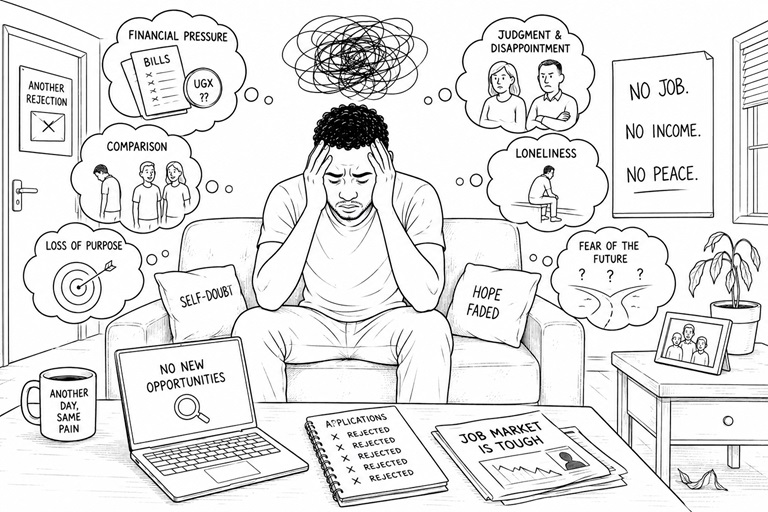
The hardest part about being unemployed as an adult is not the lack of money.It is the way unemployment slowly attacks your confidence, your dignity, your relationships, and eventually your identity.
I remember waking up every morning pretending I still had a purpose. I would iron clothes I wasn’t going to wear, scroll through job websites until my eyes hurt, and send applications to companies that never even replied. At first, I was hopeful. Everyone told me to “be patient” because jobs take time.
But weeks became months.
And patience slowly started turning into shame.
Every morning in our neighborhood, people would leave for work carrying backpacks, lunchboxes, and car keys. I would stand near the window pretending not to notice them while remaining behind in silence. The house would suddenly become too quiet after everyone left. Quiet enough for overthinking to become loud.
At first, family members were supportive.
“You’ll get something soon,” they said.
Then gradually the questions changed.
“So… any updates?”
“Have you tried calling someone?”
“What exactly do you do the whole day?”
None of the questions sounded cruel individually. But repeated every week, they became psychological pressure. You start feeling like your existence needs justification.
One afternoon, an old university friend called me.
“I got promoted,” he said excitedly.
I congratulated him genuinely. But after the call ended, I sat in darkness for nearly an hour staring at the ceiling. Not because I hated him. But because unemployment makes you measure your life against everyone else’s progress.
Social media made it worse.
People were posting office selfies, business launches, graduation photos, engagement announcements, and flights to countries I had never seen. Meanwhile, I was calculating whether I had enough data bundles to continue applying for jobs online.
That is when unemployment stopped feeling financial and became psychological.
You begin avoiding people.
You stop attending gatherings because someone will eventually ask, “So where are you working these days?” You start fearing simple conversations because you are tired of explaining your situation repeatedly.
Even your phone becomes stressful.
Unknown numbers give you hope for interviews. Rejection emails destroy your mood for entire days. Sometimes companies never respond at all, which somehow feels worse than rejection itself.
One evening, my younger sibling innocently asked me for money for something small. I didn’t have it.
That moment broke me more than I expected.
Not because the amount was large, but because adulthood teaches you that people silently expect you to provide, contribute, and survive independently. When you cannot do that, you begin feeling left behind in life itself.
The worst part is how unemployment attacks self-worth.
You start questioning your intelligence, your education, your value, and your future. You replay past mistakes repeatedly in your mind. Maybe I chose the wrong course. Maybe I wasted time. Maybe I am not talented enough. Maybe everyone else is simply better.
And because society often links success with employment, joblessness can make adults feel invisible.
People suddenly stop taking your opinions seriously. Relatives who once praised your potential begin speaking to you with subtle disappointment. Some friends stop inviting you places because they assume you cannot afford anything.
You slowly become isolated while smiling publicly.
But one thing I learned during that period is this: unemployment is not laziness.
Many unemployed adults work mentally harder than employed people. They carry anxiety every hour. They constantly think about survival, bills, expectations, applications, interviews, and the fear of becoming a burden.
That pressure can quietly drain a person emotionally.
The turning point for me came unexpectedly. An older neighbor found me sitting outside one evening and asked how life was moving. For once, I answered honestly instead of pretending everything was fine.
He listened quietly and then said something simple:
“Being unemployed does not mean you are useless. It only means your opportunity has not arrived yet.”
That sentence stayed with me.
Because unemployment has a dangerous way of making adults confuse temporary circumstances with permanent identity.
Over time, I learned to protect my mind while still searching for work. I reduced comparing myself to others. I created routines to avoid sinking into hopelessness. I kept learning small skills online. Most importantly, I stopped measuring my worth only through employment status.
Eventually, I did get an opportunity.
Not because life suddenly became fair, but because persistence finally met timing.
And when I look back now, I understand something clearly: the deepest pain of unemployment is rarely visible from outside. Many unemployed adults are fighting silent psychological battles while pretending to be okay in public.
Sometimes what they need most is not judgment or pressure.
It is dignity, encouragement, and the reminder that delayed progress is still progress.